 Revise and Resubmit - The Mayukh Show
AKS Primality Test: PRIMES is in P (Agrawal et al. 2002)
À propos de cet épisode
English Podcast starts at 00:00:00
Bengali Podcast starts at 00:24:21
Hindi Podcast starts at 00:32:14
🎙️ Welcome to "Revise and Resubmit"! 🎙️
This is the show where cutting-edge research gets the mic it deserves 📢, and we break it down with just the right mix of clarity, curiosity, and caffeine ☕💡.
Today, we dive into a paper that literally rewrote what we thought was possible in number theory. It's got primes 🔢, proofs 📚, and polynomial time ⏱️. Sounds nerdy? Oh, it is — gloriously so!
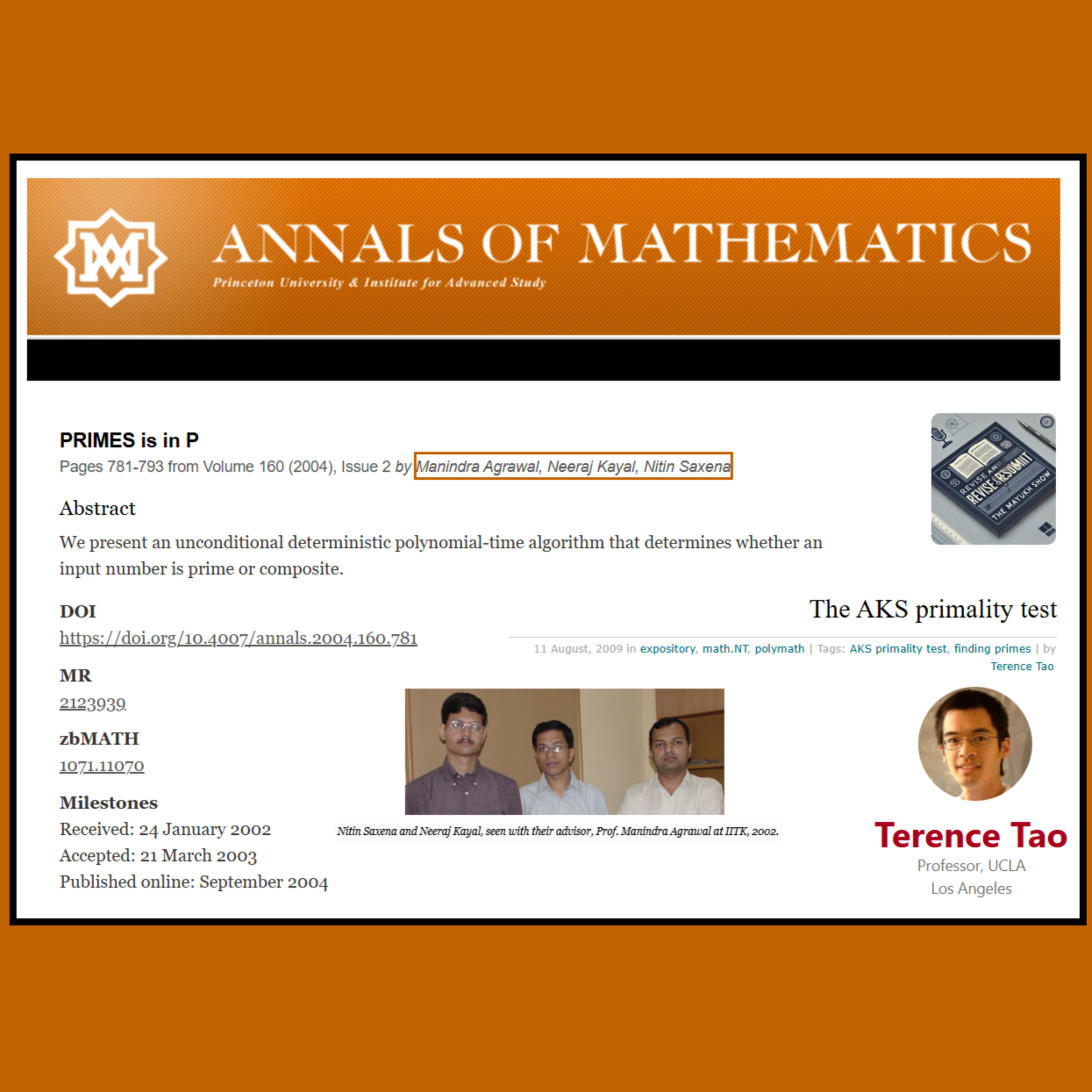
📄 Title: PRIMES is in P
👨🔬 Authors: Manindra Agrawal, Neeraj Kayal, Nitin Saxena
🏛️ Journal: Annals of Mathematics — not just any journal, but a Scopus Q1 heavyweight with an impact factor of 5.7, ranking 3rd out of 330 in mathematics!
🗓️ Published: September 2004, by Princeton University and the Institute for Advanced Study (Originally hosted on IIT Kanpur archives on 2002)
This isn’t just a paper; it’s a revolution in primality testing! 🧠
The AKS Primality Test is a deterministic, polynomial-time algorithm that finally answers the age-old question:
“Can we efficiently and certainly know if a number is prime... without relying on unproven conjectures?”
The answer? Oh, it's a YES. And it's elegant. And it’s 🔓 open access—thanks to the authors and publishers for that gift to the world 🙏!
✨ The AKS test changed everything — so why hasn’t every cryptographer tattooed it on their arm yet? 💉🔢
And how did three computer scientists from IIT Kanpur land one of the most prestigious math prizes — without touching calculus?
🔍 Stick around as we unpack this legendary result. And before we dive in, smash that Subscribe button on Spotify 🎧, YouTube's Weekend Researcher 📺, Amazon Prime 🎬, or Apple Podcasts 🍏.
Because you never know when the next episode might change what you thought math could do.
So here’s our question to kick off today:
If prime numbers are the atoms of arithmetic, what happens when we learn how to split them? 💥🔬💭
Reference
Agrawal, M., Kayal, N., & Saxena, N. (2004). PRIMES is in P. Annals of Mathematics, 160(2), 781–793. (Originally hosted on IIT Kanpur archives on 2002)
https://doi.org/10.4007/annals.2004.160.781
Tao, T. (2009, August 11). The AKS primality test. What’s New. https://terrytao.wordpress.com/2009/08/11/the-aks-primality-test/
Numberphile. (2014). Fool-Proof Test for Primes - Numberphile. In YouTube. https://www.youtube.com/watch?v=HvMSRWTE2mI
Youtube channel link
https://www.youtube.com/@weekendresearcher
Support us on Patreon
https://patreon.com/weekendresearcher
Discussion 0
Connectez-vous pour participer à la discussion