 Revise and Resubmit - The Mayukh Show
Are All Patents Equal? (Eddleston et al., 2026) | FT50 ETP
À propos de cet épisode
English Podcast Starts at 00:00:00
Bengali Podcast Starts at 00:52:50
Hindi Podcast Starts at 01:07:11
Danish Podcast Starts at 01:19:30
Reference
Eddleston, K. A., Chirico, F., & Patel, P. C. (2026). Are All Patents Equal? How Patent Attributes Shape Market Reactions to Family and Nonfamily Firm Innovation. Entrepreneurship Theory and Practice. https://doi.org/10.1177/10422587261470045
Youtube Channel
https://www.youtube.com/@weekendresearcher
Podcast Website
https://mayukhmukhopadhyay.com/reviseandresubmit
AOM SIM Curriculum Committee
https://sim.aom.org/curriculum/curriculum-committee
AOM SIM-Bytes Curriculum Lessons
https://sim.aom.org/simthrive/teaching/simbytes
🎙️ Welcome to Revise and Resubmit. 📚✨
There are moments in business when an innovation arrives quietly. A patent is granted, a document is filed, a line is added to a company’s record. And yet, somewhere beyond the paperwork, investors are watching. They are asking what this invention might say about the company that created it.
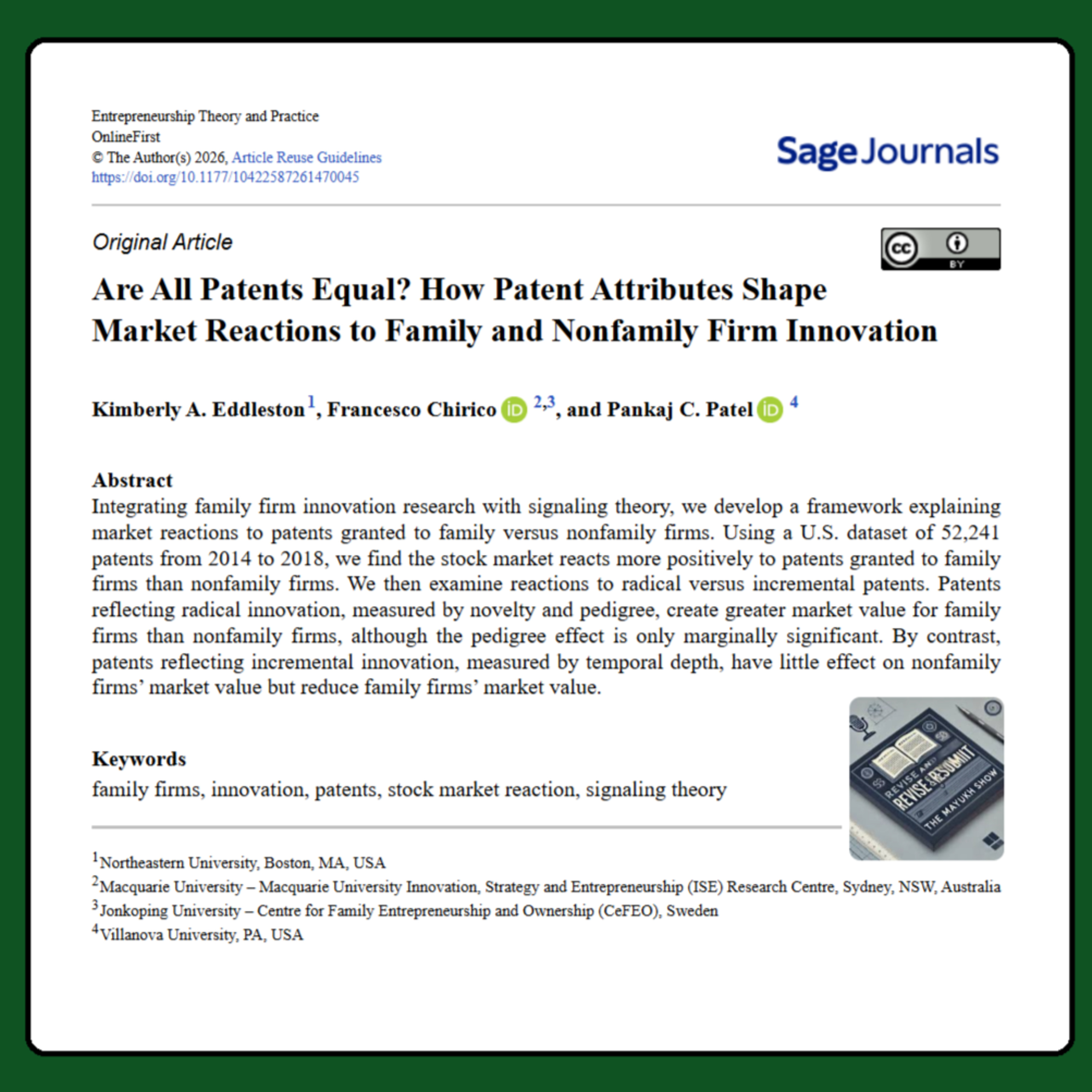
Today, we turn to a fascinating new study titled “Are All Patents Equal? How Patent Attributes Shape Market Reactions to Family and Nonfamily Firm Innovation,” by Kimberly A. Eddleston, Francesco Chirico, and Pankaj C. Patel, published online on 7 September 2026 in Entrepreneurship Theory and Practice, a prestigious FT50 journal, published by SAGE Publications. 🏛️📖
The authors examine an extraordinary dataset of 52,241 U.S. patents, asking a deceptively simple question: when a patent arrives, does the market see the same thing in every kind of company?
Apparently, not quite.
🔍 The study finds that stock markets react more positively to patents granted to family firms than to those granted to nonfamily firms. But the story becomes more intriguing when we look at the character of the innovation itself.
Radical innovations, particularly those marked by novelty and pedigree, appear to create greater market value for family firms. Incremental innovation tells a rather different story. When patents rely on older knowledge and reflect greater temporal depth, they have little effect on nonfamily firms, yet can actually reduce the market value of family firms.
Perhaps this is because innovation does more than create technology. It also communicates something about identity.
A family firm has often been imagined as cautious, traditional, perhaps reluctant to disturb what has worked before. So when such a firm produces something genuinely radical, could the patent itself become a kind of signal, quietly telling investors that their assumptions may need to be reconsidered?
💭 And perhaps that leaves us with a more unsettling question: when investors look at a patent, are they really judging the invention itself, or are they also judging the story they already believe about the company behind it?
🙏 Our thanks to Kimberly A. Eddleston, Francesco Chirico, and Pankaj C. Patel, and to SAGE Publications, for this thought-provoking contribution to the research conversation.
🎧 Subscribe to Revise and Resubmit on Spotify, and follow Weekend Researcher on YouTube. We are also available on Amazon Prime and Apple Podcasts. 🔔📚
Discussion 0
Connectez-vous pour participer à la discussion