 Revise and Resubmit - The Mayukh Show
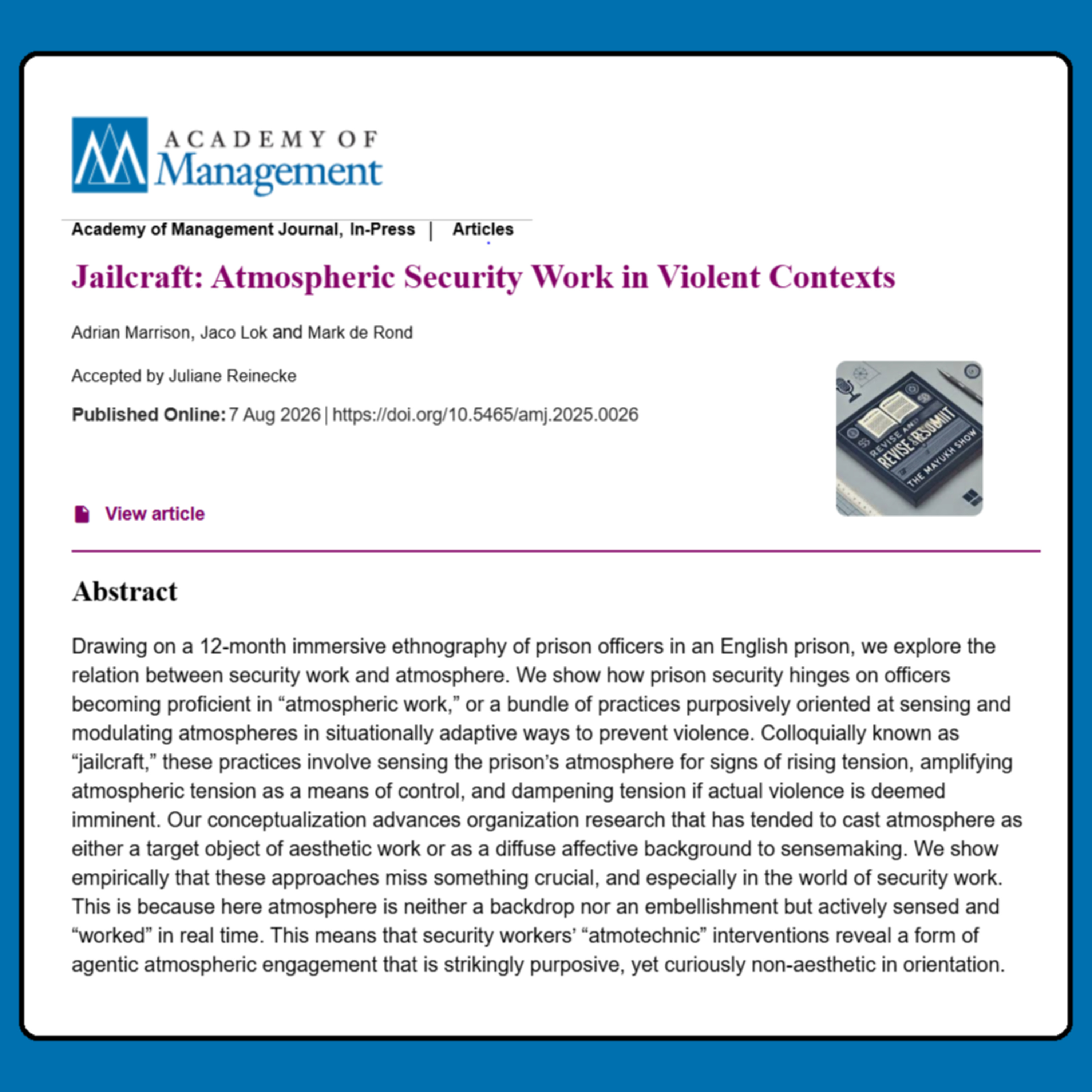
Jailcraft(Marrison et al., 2026) | FT50 AMJ
À propos de cet épisode
English Podcast Starts at 00:00:00
Bengali Podcast Starts at 00:44:38
Hindi Podcast Starts at 00:58:17
Danish Podcast Starts at 01:09:07
Reference
Marrison, A., Lok, J., & de Rond, M. (2026). Jailcraft: Atmospheric Security Work in Violent Contexts. Academy of Management Journal. https://doi.org/10.5465/amj.2025.0026
Youtube Channel
https://www.youtube.com/@weekendresearcher
Podcast Website
https://mayukhmukhopadhyay.com/reviseandresubmit
AOM SIM Curriculum Committee
https://sim.aom.org/curriculum/curriculum-committee
AOM SIM-Bytes Curriculum Lessons
https://sim.aom.org/curriculum/simbytes
🎙️ Welcome to Revise and Resubmit.
There are places where violence does not announce itself.
It gathers quietly. In a corridor. In a silence that lasts a little too long. In the way people look at one another, or perhaps in the way they suddenly stop looking.
📚 Today, I want to take you into one such world with “Jailcraft: Atmospheric Security Work in Violent Contexts”, by Adrian Marrison, Jaco Lok and Mark de Rond, published online on 7 August 2026 in the Academy of Management Journal, published by the Academy of Management.
And this is no ordinary academic journal. The Academy of Management Journal is one of the world's most prestigious management research journals and is part of the FT50 journal list, a distinction that immediately tells us something about the significance and scholarly standing of this work. 🎓
The paper draws on 12 months of immersive ethnography with prison officers in an English prison. But what the authors discover is rather more subtle than the familiar idea of security as surveillance, rules and physical control.
They call it “jailcraft.”
It is the ability to sense an atmosphere before something happens. To recognise tension gathering in the air. Sometimes to amplify that tension deliberately, as a means of control. And, when violence appears imminent, to know how to dampen it.
🌫️ What fascinated me is the paper's insistence that atmosphere is not merely something surrounding security work. It is something officers actively work on.
The body becomes an instrument. Silence becomes information. A glance, a posture, a visible presence, a carefully chosen intervention can alter the emotional temperature of an entire space.
And yet there is a troubling paradox here.
The very practices that prevent violence may also keep the possibility of violence permanently present.
That raises a much larger concern. If societies become increasingly organised around security, surveillance and the anticipation of threat, might we eventually begin carrying the atmosphere of the prison with us, even into places that are supposed to feel free?
🔍 That is where this research becomes more than a study of prison officers. It becomes a study of how we live with fear.
🙏 My sincere thanks to Adrian Marrison, Jaco Lok and Mark de Rond, and to the Academy of Management for publishing this fascinating research.
And if you enjoy conversations where academic research meets the questions beneath everyday life, please subscribe to Revise and Resubmit on Spotify and the Weekend Researcher YouTube channel. 🎧 We’re also available on Amazon Prime and Apple Podcasts.
So let me leave you with one question:
If security depends on constantly sensing the possibility of danger, what happens to us when that sense of danger becomes the atmosphere we call ordinary life? 🤔
Discussion 0
Connectez-vous pour participer à la discussion