
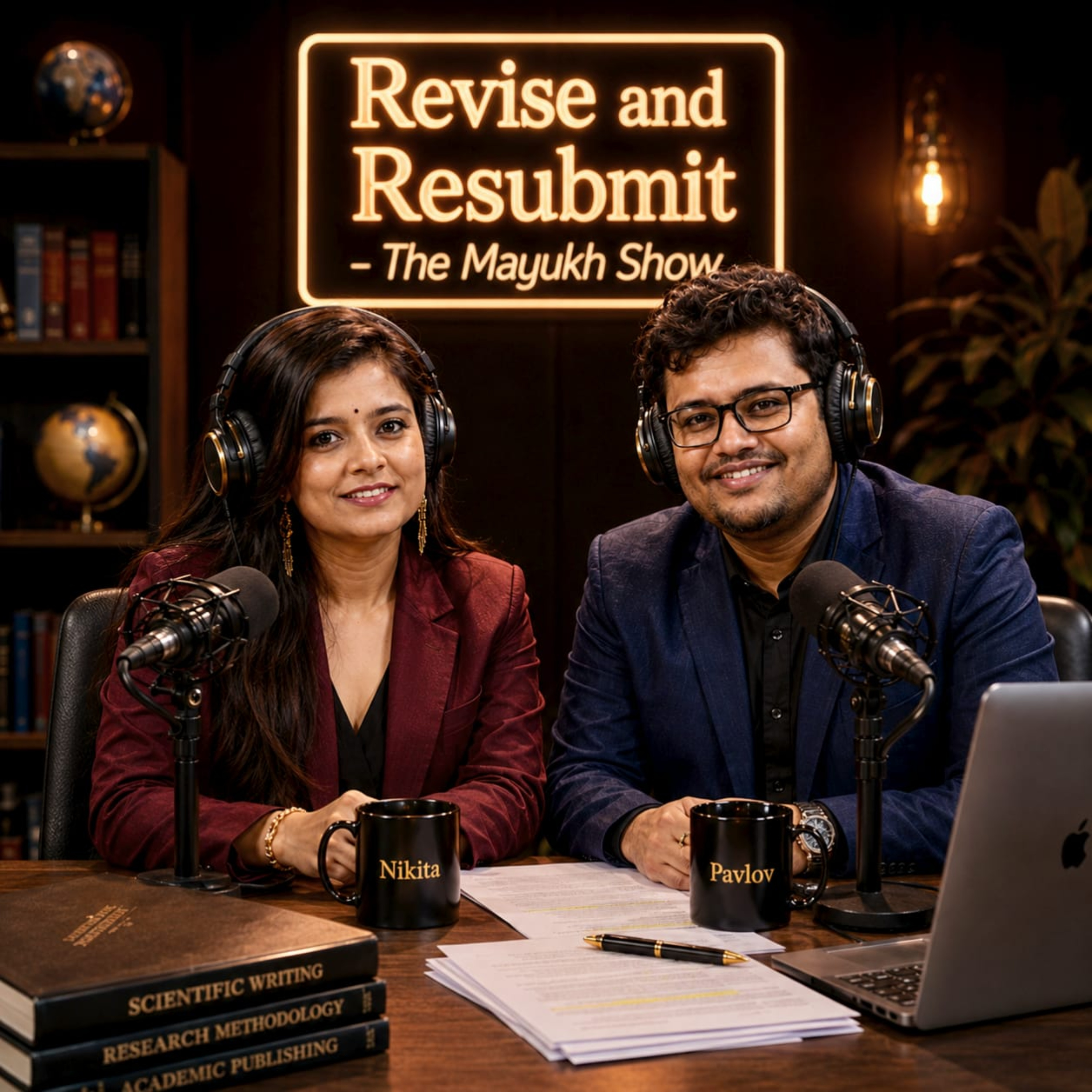
 Revise and Resubmit - The Mayukh Show
Longitude (Sobel 1995) - Weekend Classics
À propos de cet épisode
English Podcast starts at 00:00:00
Bengali Podcast Starts at 00:54:02
Hindi Podcast Starts at 01:08:49
Danish Podcast Starts at 01:30:12
Reference
Dava Sobel (1995). Longitude: The True Story of the Lone Genius Who Solved the Greatest Scientific Problem of His Time. Walker Books. https://www.amazon.in/dp/0802713122
Longitude - TV movie 2000 - International School History
https://www.youtube.com/watch?v=--b0eaKGWwE
Noiser Podcast - Brief History of Longitude
https://www.noiser.com/short-history-of/longitude
Youtube channel link
https://www.youtube.com/@weekendresearcher
Podcast Website
https://mayukhmukhopadhyay.com/reviseandresubmit
🎙️ Welcome to Revise and Resubmit, and to another episode of Weekend Classics! 📚✨
Imagine setting sail across an unforgiving ocean, with no land in sight, no reliable way to know your exact position, and a single navigational mistake capable of costing hundreds of lives. Now imagine that the solution to this terrifying problem lies not in the heavens, as the greatest scientists of the age believed, but in the hands of a stubborn clockmaker.
That is the extraordinary story I discovered in Longitude: The True Story of a Lone Genius Who Solved the Greatest Scientific Problem of His Time, by Dava Sobel, first published in 1995.
🌊 Sobel, an American science writer celebrated for bringing complex scientific ideas to life, has a particular gift for finding the human drama hidden inside scientific history. In books such as Galileo's Daughter and The Glass Universe, she explores the people behind remarkable discoveries. Here, she turns her attention to John Harrison, an English clockmaker whose determination challenged the scientific establishment of eighteenth-century Europe.
🕰️ The problem was deceptively simple to describe and extraordinarily difficult to solve. Sailors could estimate latitude, but longitude at sea remained elusive. Without an accurate way to compare local time with the time at a fixed reference point, ships could lose their bearings, fortunes could disappear beneath the waves, and entire expeditions could end in disaster.
In 1714, the British Parliament offered a staggering reward of £20,000 for a practical solution. Astronomers pursued answers among the stars. Harrison looked towards the clock.
What followed was a decades-long struggle involving ingenious inventions, professional rivalries, institutional resistance, and a man who refused to surrender his life's work. 🔍
What I find most compelling about Sobel's account is that this is not merely a story about timekeeping. It is about what happens when an unconventional mind challenges people who are convinced they already know where the answer must lie.
And sometimes, as Harrison's story suggests, the greatest obstacle to a discovery is not the problem itself, but the difficulty of persuading others that the solution is possible.
🙏 My sincere thanks to Dava Sobel and Walker Books for bringing this remarkable chapter of scientific history to readers.
🎧 If you enjoy Revise and Resubmit, please subscribe on Spotify and to Weekend Researcher on YouTube. You can also find the channel on Amazon Prime Music and Apple Podcasts.
❓ And as we set sail with John Harrison, here is the question I cannot help asking: when an entire establishment believes you are wrong, how do you find the courage to keep working until the world finally catches up with you?
Discussion 0
Connectez-vous pour participer à la discussion