 Revise and Resubmit - The Mayukh Show
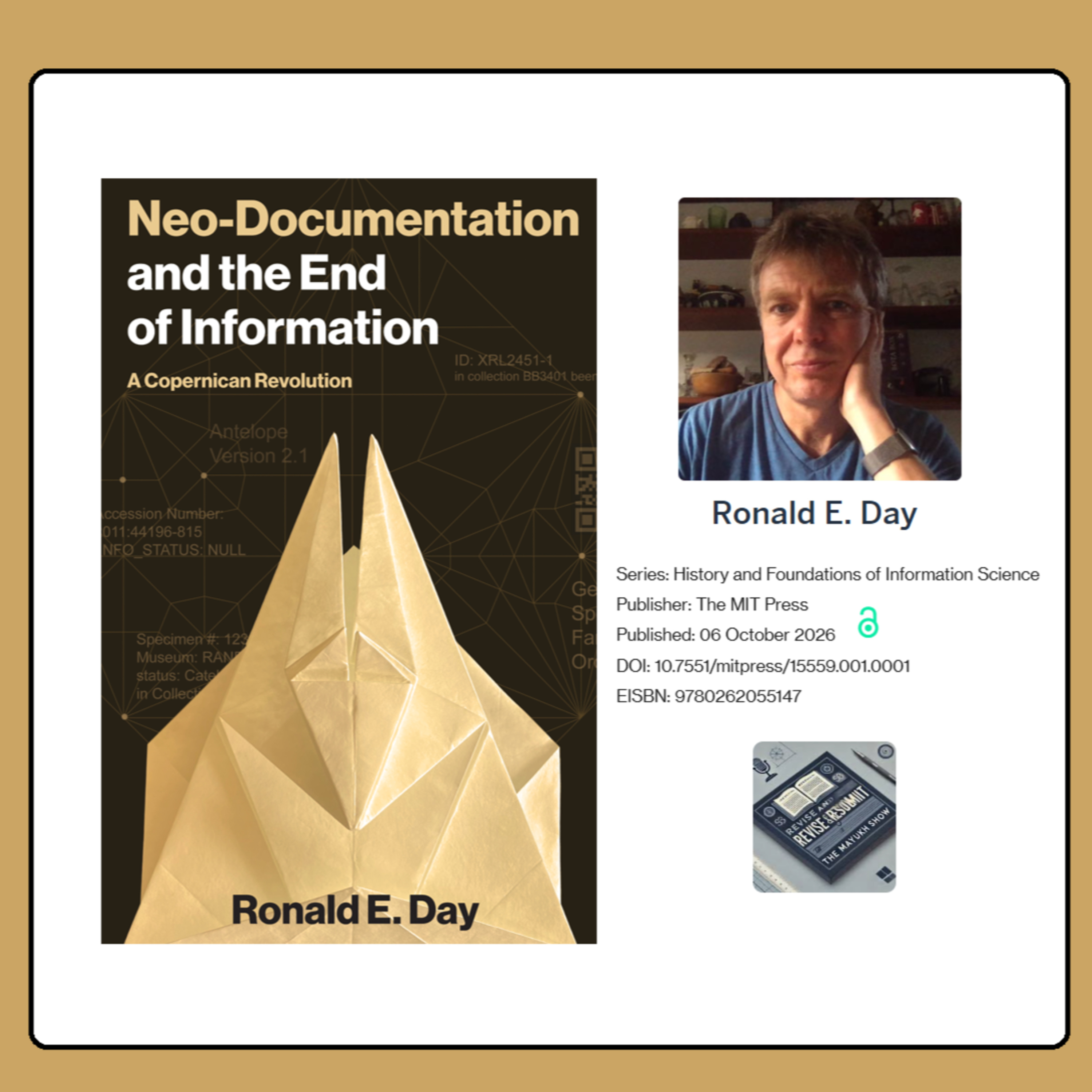
Neo-Documentation and the End of Information (Day 2026) - Weekend Book Review
À propos de cet épisode
English Podcast starts at 00:00:00
Bengali Podcast Starts at 00:50:55
Hindi Podcast Starts at 01:03:50
Danish Podcast Starts at 01:17:47
Reference
Ronald E. Day (2026). Neo-Documentation and the End of Information: A Copernican Revolution. MIT Press. https://doi.org/10.7551/mitpress/15559.001.0001
Youtube channel link
https://www.youtube.com/@weekendresearcher
Podcast Website
https://mayukhmukhopadhyay.com/reviseandresubmit
AOM SIM Curriculum Committee
https://sim.aom.org/curriculum/curriculum-committee
🎙️ Welcome to Revise and Resubmit, and to another episode of Weekend Book Review!
📚 What if I told you that information, the very currency of our digital age, is not quite what we have always believed it to be? What if a document does not simply record reality, but helps determine what reality means, what counts as evidence, and ultimately, what we choose to believe?
Today, I explore a fascinating and intellectually provocative book, Neo-Documentation and the End of Information: A Copernican Revolution, by Ronald E. Day, published by MIT Press on 6 October 2026.
🧠 Day is Professor of Information and Library Science at Indiana University Bloomington, and a distinguished scholar whose work brings critical theory, philosophy, and information science into a searching conversation. With a background spanning philosophy, comparative literature, and library and information science, he has spent much of his career questioning assumptions that others have been content to accept. His earlier book, Indexing It All, received the Association for Information Science and Technology's Best Information Science Book Award in 2015. Clearly, Day is not interested in taking information at face value.
And that, perhaps, is where this new book becomes particularly compelling.
For generations, we have tended to think of documents as containers, neat repositories of facts waiting to be retrieved. Day challenges this comfortable picture. Drawing on Martin Heidegger, Bruno Latour, and the tradition of neo-documentation, he invites us to consider documents as relational, contextual, and transformative entities. A document becomes meaningful not merely because something is written upon it, but because people, institutions, technologies, and circumstances give it evidentiary force.
✨ From Paul Otlet's ambitious dream of organising the world's knowledge to the contemporary challenges posed by artificial intelligence, Day asks us to reconsider what information actually is. His proposed Copernican revolution is not simply a change in terminology. It is a challenge to the foundations on which we organise knowledge, preserve records, interpret evidence, and increasingly entrust machines to make sense of our world.
I find the implications especially striking in an age when information is abundant, yet certainty often seems painfully scarce. Perhaps the question is no longer how much information we possess, but how meaning comes into being.
🙏 My sincere thanks to Professor Ronald E. Day for this thought-provoking contribution, and to MIT Press for bringing this important work to readers.
💛 If you enjoy books that challenge familiar assumptions and open unexpected intellectual doors, subscribe to Revise and Resubmit on Spotify and Weekend Researcher on YouTube. You can also find the podcast on Amazon Prime Music and Apple Podcasts.
❓ And let me leave you with one question: If information does not simply describe the world but helps shape what we recognise as reality, then in an age increasingly governed by artificial intelligence, who gets to decide what counts as truth?
Discussion 0
Connectez-vous pour participer à la discussion