 Revise and Resubmit - The Mayukh Show
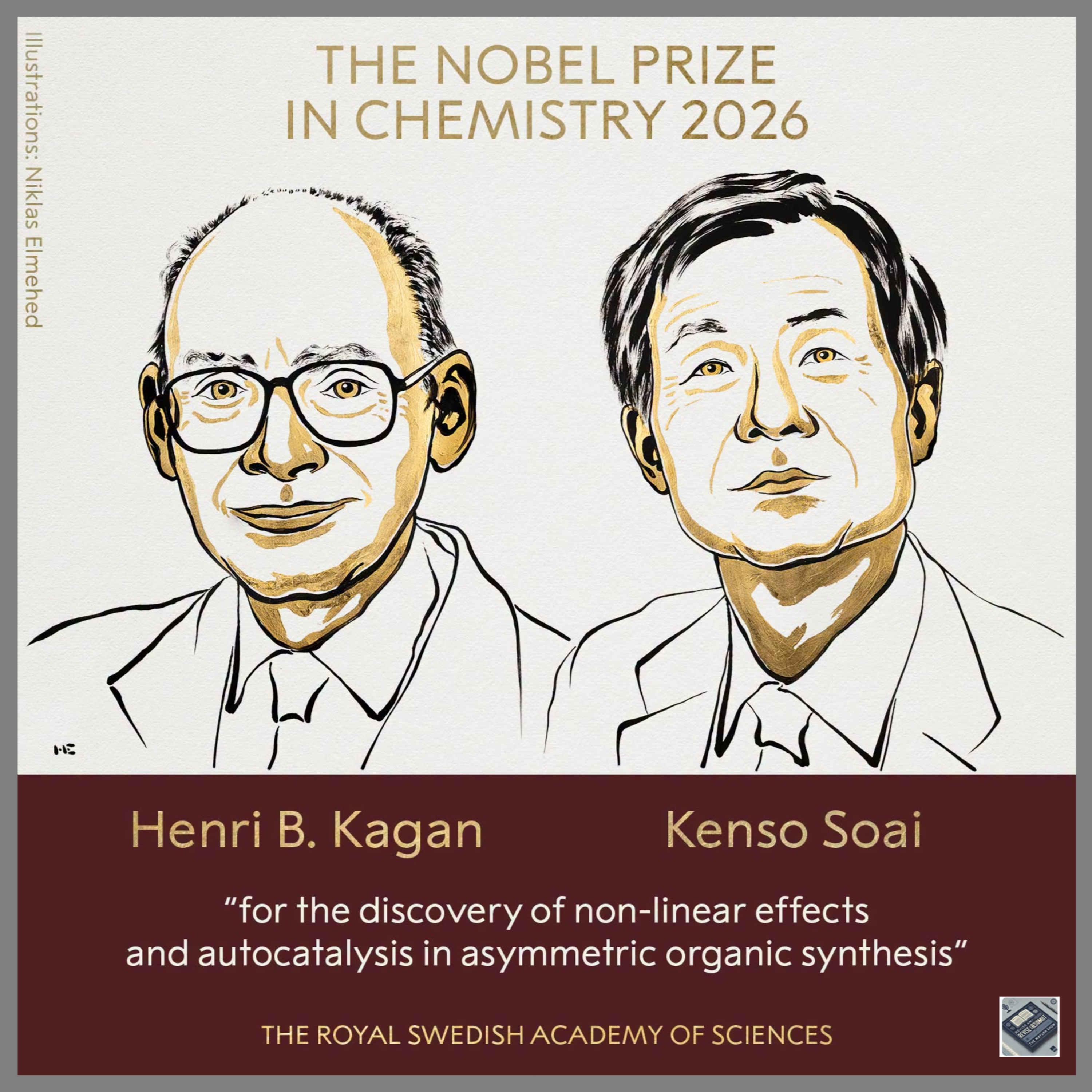
Nobel Prize in Chemistry 2026 - Henri B. Kagan and Kenso Soai
À propos de cet épisode
English Podcast Starts at 00:00:00
Bengali Podcast Starts at 00:53:06
Hindi Podcast Starts at 01:10:34
Danish Podcast Starts at 01:30:30
Nobel Prize in Chemistry 2026. NobelPrize.org. Nobel Prize Outreach 2026. Wed. 7 Oct 2026. <https://www.nobelprize.org/prizes/chemistry/2026/summary/>
Press release: https://www.nobelprize.org/prizes/chemistry/2026/press-release/
Popular information: https://www.nobelprize.org/prizes/chemistry/2026/popular-information/
Advanced information: https://www.nobelprize.org/prizes/chemistry/2026/advanced-information/
🎙️ Welcome to Revise and Resubmit.
There are moments in science when a discovery doesn't merely answer a question. It changes the question itself. And today's story begins with something almost impossibly small: a tiny imbalance between two forms of the same molecule. 🧪✨
On 7 October 2026, the Royal Swedish Academy of Sciences awarded the Nobel Prize in Chemistry to Henri B. Kagan and Kenso Soai, for their discoveries concerning non-linear effects and autocatalysis in asymmetric organic synthesis.
🏆 The Nobel Prize in Chemistry is among the world's most prestigious scientific honours. And this year's work takes us into a fascinating world where molecules can, in effect, help decide their own future.
Kagan, born in 1930 in Boulogne-Billancourt, France, discovered the remarkable phenomenon of non-linear effects. His work showed that the stereochemical purity of a chemical product need not simply mirror that of the catalyst used to create it. A small molecular advantage could become something much larger.
Then comes Soai.
Born in 1950 in Hiroshima, Japan, Kenso Soai discovered what became known as the Soai reaction, one of the most striking examples of asymmetric autocatalysis. Here, a chiral product can catalyse the formation of more of itself while dramatically amplifying an initially tiny imbalance. 🔄🧬
And suddenly, chemistry becomes almost like a mystery novel.
A molecule begins with the faintest hint of preference. Then that preference is repeated. Amplified. Reinforced. Until one molecular form dominates.
Why does that matter?
Because it reaches far beyond the laboratory. These discoveries illuminate the profound problem of biological homochirality, the remarkable fact that living systems overwhelmingly favour one molecular handedness. They may even offer clues to one of chemistry's most enduring questions: how did the molecular asymmetry of life begin? 🌍🔬
Kagan and Soai will share the 12 million Swedish kronor Nobel Prize equally.
🎧 If you enjoy Revise and Resubmit, subscribe on Spotify and to Weekend Researcher on YouTube. You can also find the channel on Amazon Prime and Apple Podcasts.
So, before we begin, here's the question I cannot quite put aside:
❓ If life itself began with the amplification of a tiny molecular accident, how would we ever know which moment was the beginning?
Discussion 0
Connectez-vous pour participer à la discussion