 Revise and Resubmit - The Mayukh Show
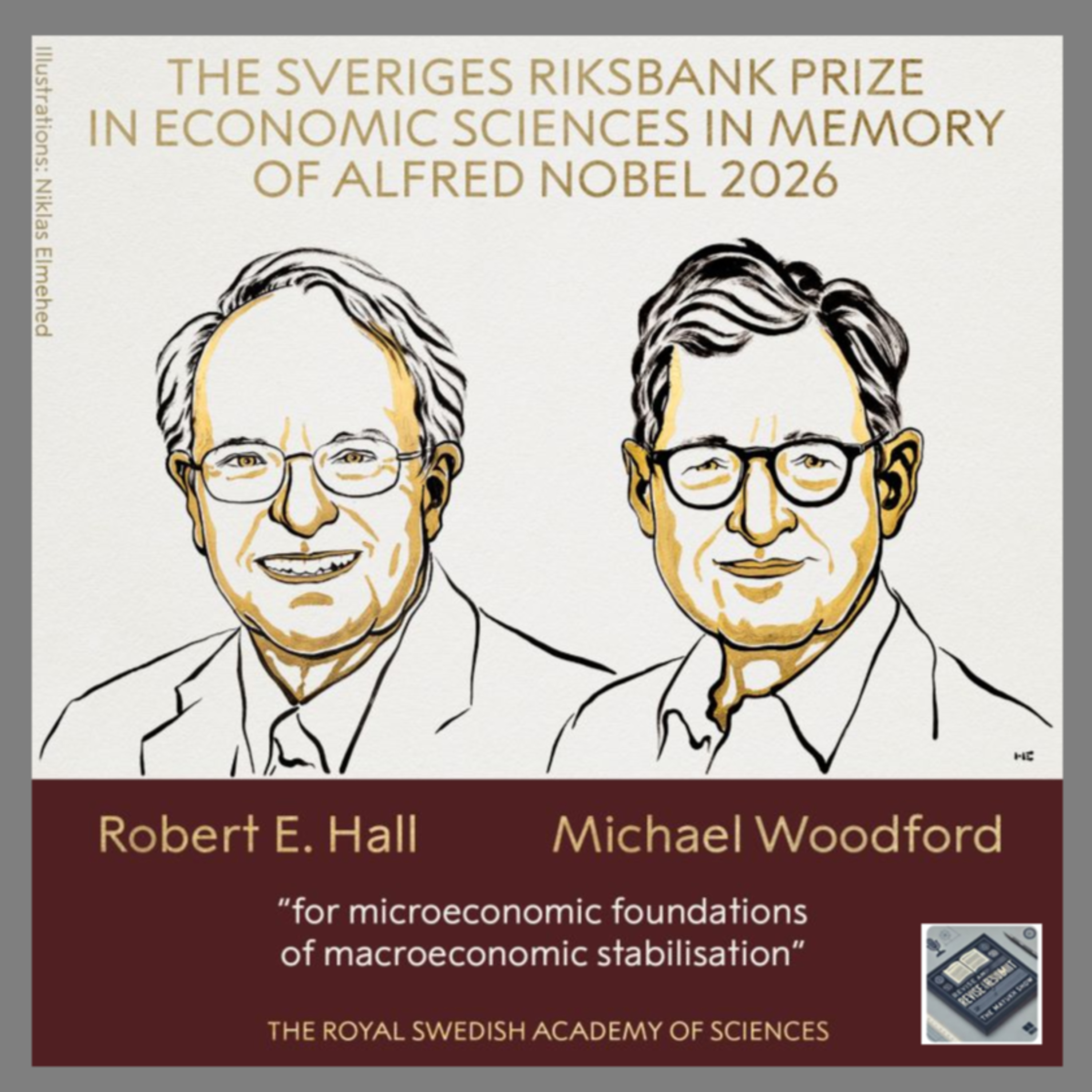
Nobel Prize in Economics 2026 - Robert E. Hall and Michael Woodford
À propos de cet épisode
English Podcast Starts at 00:00:00
Bengali Podcast Starts at 00:55:42
Hindi Podcast Starts at 01:09:41
Danish Podcast Starts at 01:20:30
Sveriges Riksbank Prize in Economic Sciences in Memory of Alfred Nobel 2026. NobelPrize.org. Nobel Prize Outreach 2026. Mon. 12 Oct 2026. <https://www.nobelprize.org/prizes/economic-sciences/2026/summary/>
Press Release: https://www.nobelprize.org/prizes/economic-sciences/2026/press-release/
Popular information: https://www.nobelprize.org/prizes/economic-sciences/2026/popular-information/
Advanced information: https://www.nobelprize.org/prizes/economic-sciences/2026/advanced-information/
Youtube Channel
https://www.youtube.com/@weekendresearcher
Podcast Website
https://mayukhmukhopadhyay.com/reviseandresubmit
🎙️ Welcome to Revise and Resubmit.
Imagine a world where governments are trying to tame inflation, central banks are adjusting interest rates, and millions of households are quietly deciding whether to spend, save, borrow, or wait. Now imagine discovering that the key to understanding the entire economy lies in those individual decisions. 💰🌍
That is the fascinating territory we enter today.
On 12 October 2026, the Royal Swedish Academy of Sciences announced the 2026 Sveriges Riksbank Prize in Economic Sciences in Memory of Alfred Nobel, awarded to Robert E. Hall and Michael Woodford for their work on the microeconomic foundations of macroeconomic stabilisation.
🏆 This prestigious prize recognises research that has helped reshape modern economic thinking, influencing how central banks and governments understand economic fluctuations and respond to crises.
First, there is Robert E. Hall, born in Palo Alto, California, in 1943, and a professor at Stanford University. His work transformed how economists think about household consumption. If people make decisions using all the information available to them, Hall showed, unexpected changes in consumption become especially important. His ideas helped illuminate consumption smoothing, as well as the circumstances of households that must spend what they earn almost immediately.
Then comes Michael Woodford, born in Chicopee, Massachusetts, in 1955, and a professor at Columbia University. Through his influential work, particularly Interest and Prices, Woodford helped establish the New Keynesian framework, connecting sticky prices and forward-looking decisions with monetary policy. 📊
Together, their contributions help explain how countless individual choices combine to shape inflation, employment, and economic growth. Their work gives policymakers a more rigorous framework for asking what happens when interest rates rise, government spending changes, or households and businesses revise their expectations.
And that is where the story becomes personal. Behind every economic model are people deciding whether they can afford a home, whether a business should hire another worker, and whether tomorrow feels secure enough to spend today.
💡 The two laureates will share the prize of 12 million Swedish kronor equally.
🎧 If you enjoy Revise and Resubmit, please subscribe to our podcast on Spotify and to Weekend Researcher on YouTube. You can also find the channel on Amazon Prime and Apple Podcasts.
❓ So, as we explore the ideas that help guide the world's economies, here is the question I leave you with: if millions of private decisions can move an entire economy, can even the wisest central bank ever truly predict what people will do next?
Discussion 0
Connectez-vous pour participer à la discussion