 Revise and Resubmit - The Mayukh Show
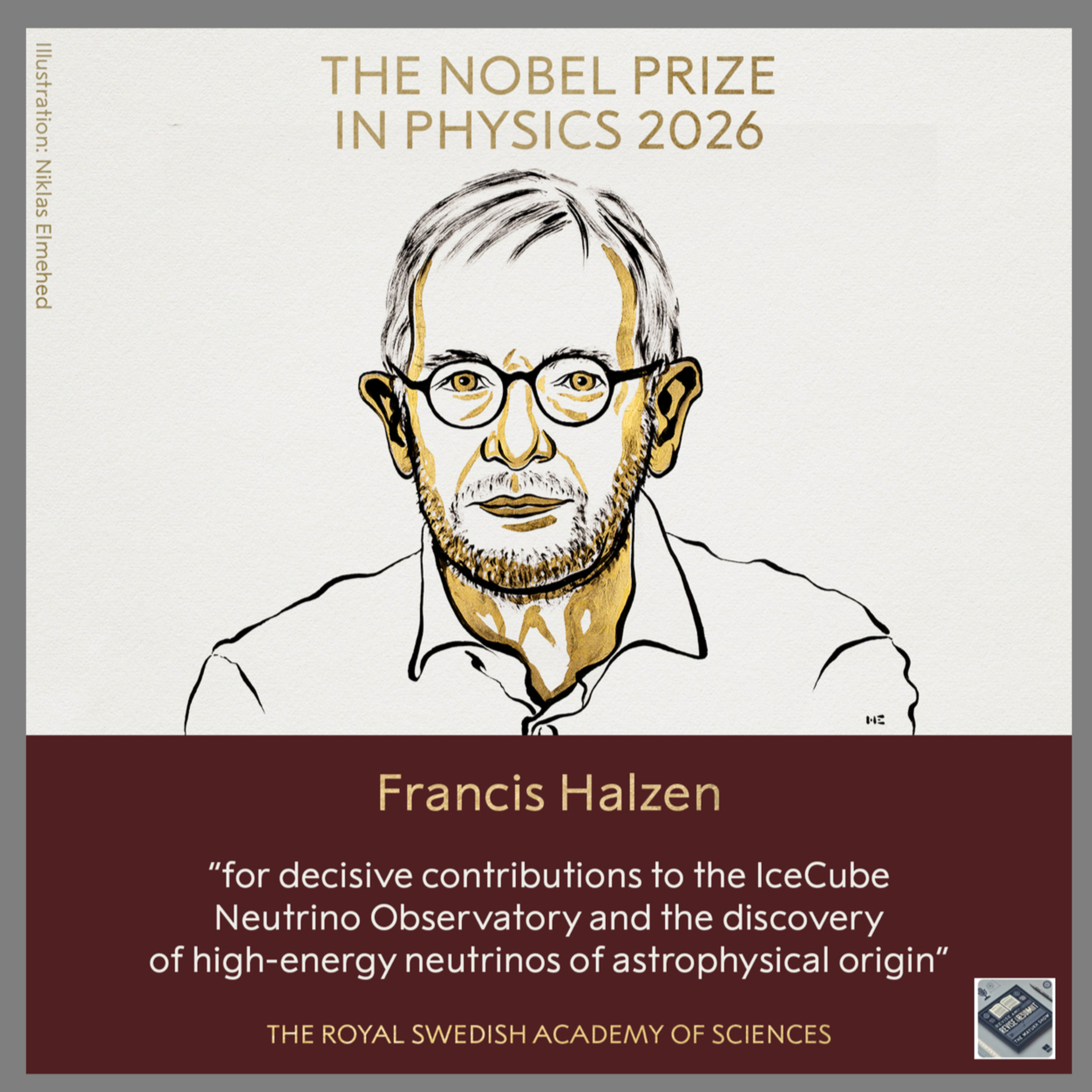
Nobel Prize in Physics 2026 - Francis Halzen
À propos de cet épisode
English Podcast Starts at 00:00:00
Bengali Podcast Starts at 01:17:45
Hindi Podcast Starts at 01:36:48
Danish Podcast Starts at 02:02:42
Nobel Prize in Physics 2026. NobelPrize.org. Nobel Prize Outreach 2026. Tue. 6 Oct 2026. <https://www.nobelprize.org/prizes/physics/2026/summary/>
Press release: https://www.nobelprize.org/prizes/physics/2026/press-release/
Popular information: https://www.nobelprize.org/prizes/physics/2026/popular-information/
Advanced information: https://www.nobelprize.org/prizes/physics/2026/advanced-information/
Youtube Channel
https://www.youtube.com/@weekendresearcher
Podcast Website
https://mayukhmukhopadhyay.com/reviseandresubmit
🎙️ Welcome to Revise and Resubmit.
Today, we're going somewhere very cold, very dark, and very far away. ❄️🌌
On 6 October 2026, the Royal Swedish Academy of Sciences awarded the Nobel Prize in Physics to Francis Halzen for his decisive contributions to the IceCube Neutrino Observatory and the discovery of high-energy neutrinos of astrophysical origin.
🏆 This is the Nobel Prize in Physics, one of the world's most prestigious recognitions in science. And the story behind this year's prize begins with a particle that is almost absurdly difficult to catch.
The neutrino has no electric charge. It barely interacts with matter. It can pass through enormous quantities of material, travel across the universe, and arrive here carrying information from some of the most violent places in existence. 🌠
But how do you catch something that almost never stops?
You build a detector inside a cubic kilometre of Antarctic ice. 🧊🔬
Halzen's work helped turn that extraordinary idea into the IceCube Neutrino Observatory, building on earlier efforts such as AMANDA. Thousands of optical sensors were buried deep beneath the South Pole, waiting for the faint flashes of light produced when neutrinos finally interact with the ice.
And when those flashes appear, they tell a story.
A track can reveal a direction. A cascade can reveal an interaction. Together, these rare signals allow scientists to investigate distant cosmic accelerators and begin exploring the universe through a new kind of messenger.
🌌 Think about that for a moment. Light has long been our way of looking into space. But neutrinos offer something different. They can travel through places where light may be blocked or transformed, carrying clues from environments we could never see directly.
Francis Halzen, born in 1944 in Tienen, Belgium, earned his PhD from KU Leuven in 1969 and became a professor at the University of Wisconsin-Madison. His Nobel Prize comes with 12 million Swedish kronor.
🎧 If you enjoy Revise and Resubmit, please subscribe on Spotify and subscribe to Weekend Researcher on YouTube. You can also find the channel on Amazon Prime and Apple Podcasts.
✨ So, as we look down into the Antarctic ice and out towards the deepest reaches of space, I have to wonder:
❓ What if the universe has been sending us messages all along, and we are only now learning how to hear them?
Discussion 0
Connectez-vous pour participer à la discussion