 Revise and Resubmit - The Mayukh Show
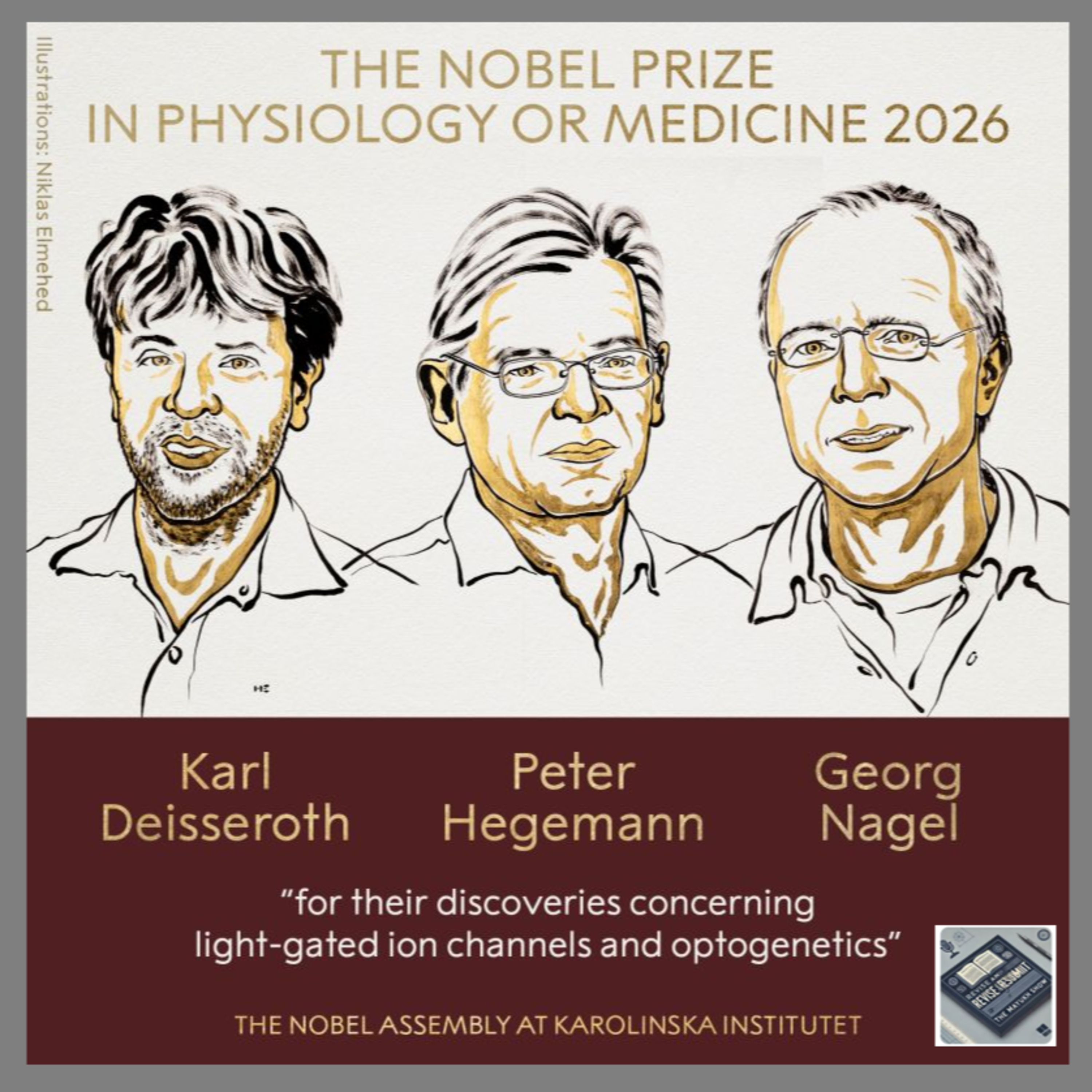
Nobel Prize in Physiology or Medicine 2026
À propos de cet épisode
English Podcast Starts at 00:00:00
Bengali Podcast Starts at 00:44:36
Hindi Podcast Starts at 01:06:01
Danish Podcast Starts at 01:24:26
Nobel Prize in Physiology or Medicine 2026. NobelPrize.org. Nobel Prize Outreach 2026. Mon. 5 Oct 2026. <https://www.nobelprize.org/prizes/medicine/2026/summary/>
Press release: https://www.nobelprize.org/prizes/medicine/2026/press-release/
Popular information: https://www.nobelprize.org/prizes/medicine/2026/popular-information/
Advanced information: https://www.nobelprize.org/prizes/medicine/2026/advanced-information/
Youtube Channel
https://www.youtube.com/@weekendresearcher
Podcast Website
https://mayukhmukhopadhyay.com/reviseandresubmit
🎙️ Welcome to Revise and Resubmit.
Today, we are talking about a discovery that sounds almost like science fiction: using light to control the brain. 💡🧠
On 5 October 2026, the Nobel Assembly at Karolinska Institutet awarded the Nobel Prize in Physiology or Medicine to Karl Deisseroth, Peter Hegemann, and Georg Nagel, “for their discoveries concerning light-gated ion channels and optogenetics.” This is, quite simply, one of the most prestigious recognitions in science.
And what did they discover?
Well, imagine having a tiny switch inside a nerve cell. Now imagine that switch responding to light. 🔦
That is the extraordinary idea behind optogenetics.
Peter Hegemann and Georg Nagel's work on light-sensitive proteins called channelrhodopsins, found in green algae, revealed that light could open channels through cell membranes. Karl Deisseroth then helped transform that biological curiosity into a powerful neuroscience tool, allowing researchers to activate or inhibit precisely targeted neurons with light.
Suddenly, scientists were no longer limited to watching the brain and asking what might be happening. They could intervene. They could switch particular neural circuits on or off and begin asking something much more powerful:
Does this circuit actually cause this behaviour, this memory, this emotion? 🧩
That shift has changed neuroscience. Optogenetics has helped researchers investigate the neural foundations of behaviour and memory, and it has even opened clinical possibilities, including experimental approaches to restoring vision.
And there is something wonderfully simple about the story. A protein that evolved in a tiny organism responding to sunlight eventually became part of humanity's attempt to understand one of the most complicated objects we know: the living brain.
🏆 Deisseroth, Hegemann, and Nagel will share the 12 million Swedish kronor prize equally, marking a remarkable moment in modern neuroscience.
🎧 If you enjoy Revise and Resubmit, please subscribe to the channel on Spotify and to Weekend Researcher on YouTube. You can also find the channel on Amazon Prime and Apple Podcasts.
So, before we begin, here is the question I cannot quite shake:
❓ If light can switch individual neurons on and off, how much of who we are might one day be understood as a pattern of switches waiting to be discovered?
Discussion 0
Connectez-vous pour participer à la discussion