
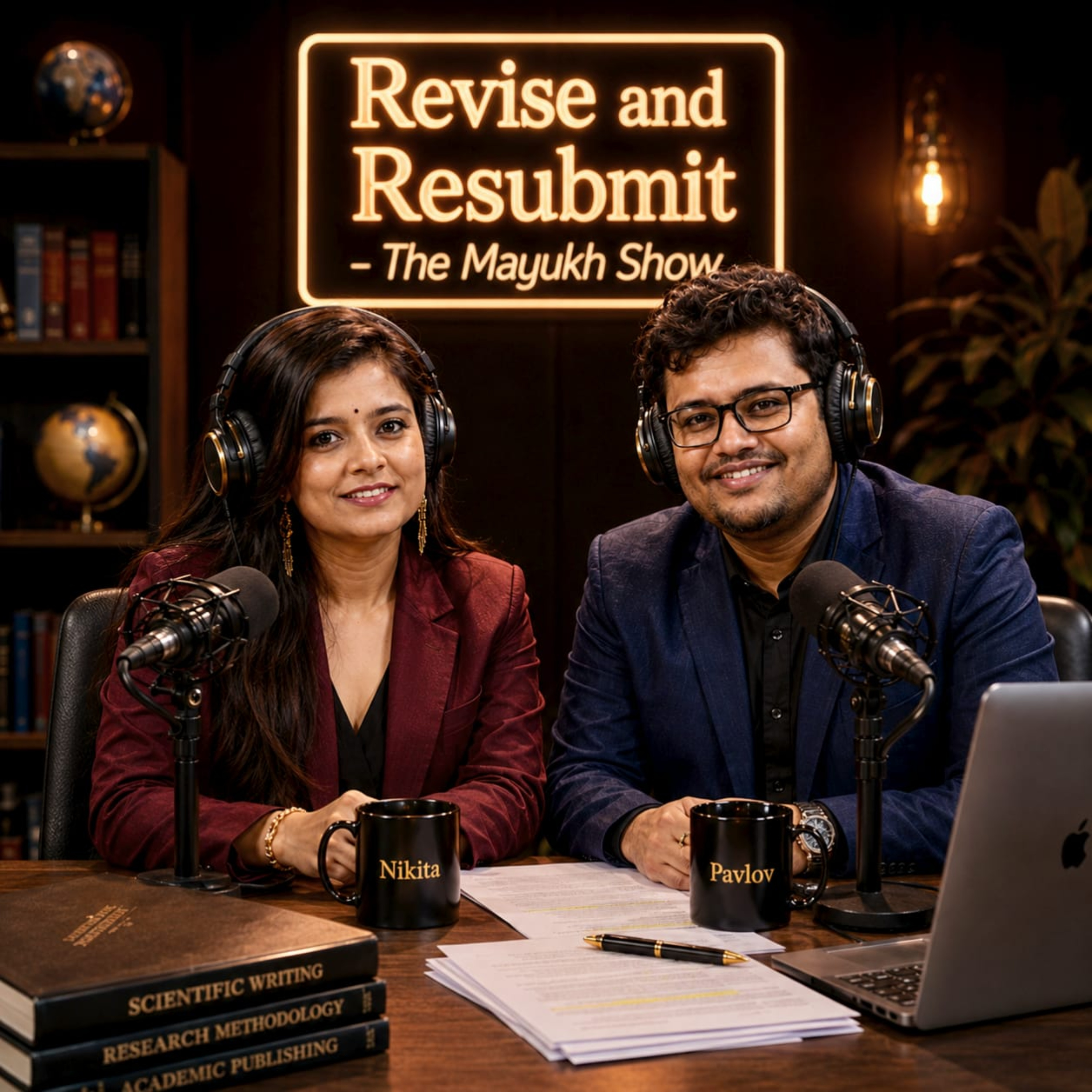
 Revise and Resubmit - The Mayukh Show
The Scaling Curve (Claude & Sacerdoti 2026) - Weekend Book Review
À propos de cet épisode
English Podcast Start at 00:00:00
Bengali Podcast Start at 00:41:57
Hindi Podcast Start at 01:05:14
Danish Podcast Start at 01:28:22
Reference
Claude St. John (2026). The Scaling Curve. Titanium Books. https://www.amazon.in/Scaling-Curve-Anthropic-Survive-Superintelligence-ebook/dp/B0GPJDNLQ8
I "wrote" a 250-page book over two weekends. - Tod Sacerdoti
https://www.linkedin.com/posts/sacerdoti_i-wrote-a-250-page-book-over-two-weekends-share-7431747258934677504-jv-d/
Youtube channel link
https://www.youtube.com/@weekendresearcher
Podcast Website
https://mayukhmukhopadhyay.com/reviseandresubmit
🎙️✨ Welcome to Revise and Resubmit, and welcome to another episode of Weekend Book Review! 📚🤖
There are books about artificial intelligence that leave me impressed by the machines. And then there are books that leave me wondering about the people who build them. The Scaling Curve: Dario Amodei, Anthropic, and the Race to Build and Survive Superintelligence belongs firmly in the second category.
As I began reading, I kept returning to one unsettling thought: what if the people most frightened by a technology are also the people who feel they have the greatest responsibility to build it? 🌌
Written under the pseudonym Claude St. John, the book explores the remarkable journey of Dario Amodei, from a childhood shaped by an intense search for objective truth, through his work in biophysics, neuroscience, Baidu and Google Brain, to his pivotal role in discovering the scaling patterns that helped transform modern AI.
And then comes the extraordinary decision. In 2021, Amodei left OpenAI and, alongside his sister Daniela and a small group of colleagues, helped create Anthropic, built around an idea that initially sounds almost contradictory: perhaps the people most concerned about powerful AI should be the ones developing it. 🧠⚡
What makes this story fascinating to me is that contradiction at its centre. Amodei has warned that advanced AI could pose extraordinary risks to humanity. Yet he continues to build increasingly capable systems, including Claude, because he believes that understanding the danger may require confronting it directly.
The book moves between biography, technology, business, philosophy and warning. It takes us through scaling laws, the turbulence surrounding OpenAI, Anthropic's rise, the FTX connection, and the enormous question hanging over all of it: can we build something vastly more intelligent than ourselves without losing control of it? 🌍🔬
There is another fascinating layer here. Claude St. John is not a traditional biographical author, but a pseudonym used by Tod Sacerdoti in an AI-assisted publishing experiment. That makes the book's own creation strangely relevant to its subject. A book about the people building AI has itself emerged from a process involving AI.
And perhaps that is where I found myself most intrigued. 📖✨
We often ask whether machines will become intelligent enough to change humanity. But perhaps the quieter question is what happens to us while we are building them.
❓If the people racing toward superintelligence are also the people warning us about its dangers, how can we know when responsibility has become courage, and when it has quietly become ambition?
🙏 My thanks to Tod Sacerdoti, publishing under the name Claude St. John, and to Titanium Books for bringing this provocative book to readers.
🎧 If you enjoy Weekend Book Review, please subscribe to Revise and Resubmit on Spotify and to the Weekend Researcher channel on YouTube. 📺 You can also listen to us on Amazon Prime Music and Apple Podcasts.
🌟 Until next time, keep reading, keep questioning, and perhaps most importantly, keep wondering what the future is asking of us.
Discussion 0
Connectez-vous pour participer à la discussion