 Revise and Resubmit - The Mayukh Show
Typology of Threat Culture in the Metaverse (Mukhopadhyay 2025) | AOM2025 LLM-Assisted Podcast
À propos de cet épisode
English Podcast starts at 00:00:00
Hindi Podcast starts at 00:05:26
Dansk Podcast starts at 00:12:36
🎙️ Welcome to the AOM2025 Poster Session Podcast! 🎉
You're tuning in to a very special episode titled:
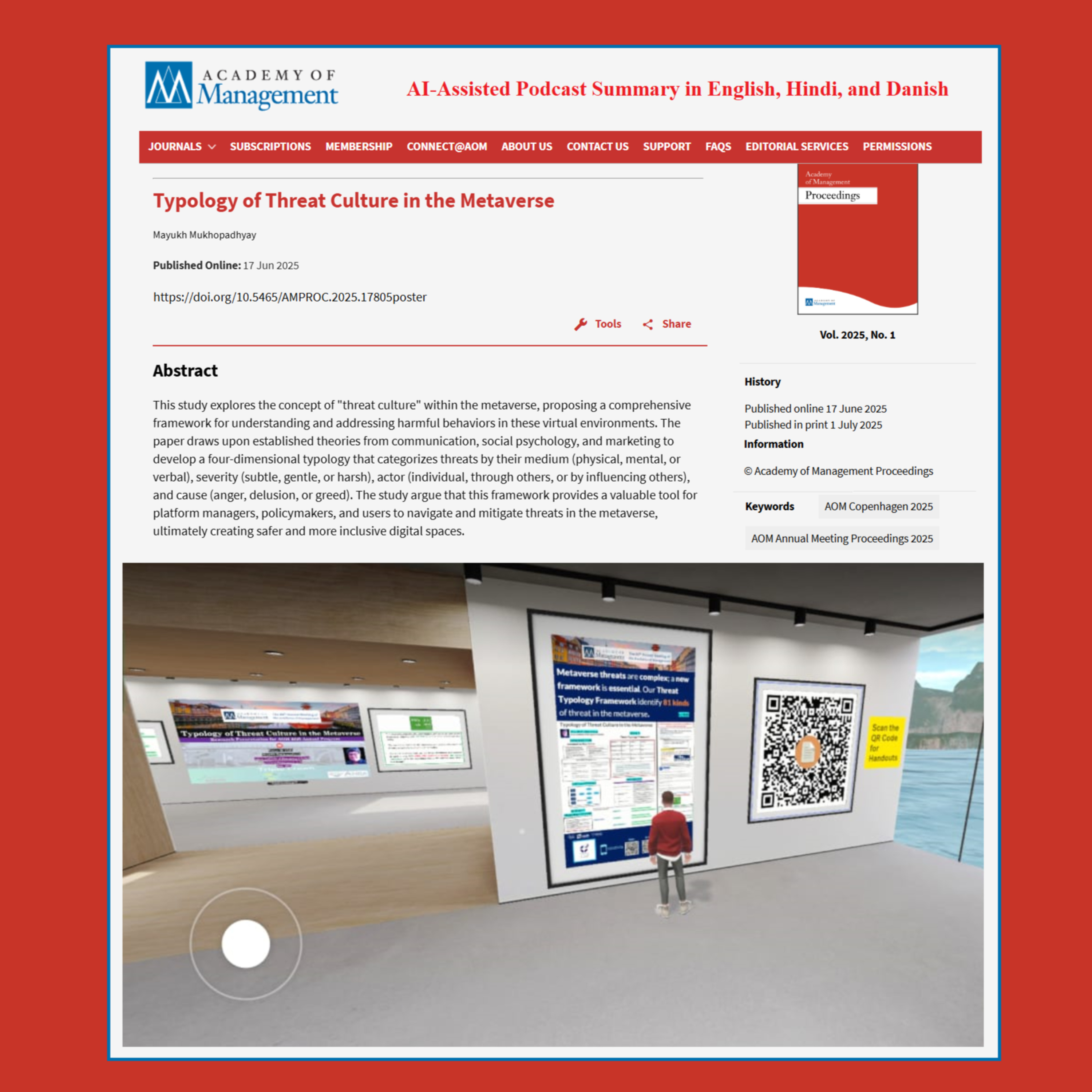
✨ "Typology of Threat Culture in the Metaverse" ✨
I'm bringing you a NotebookLM assisted summary of a contribution to the Academy of Management Proceedings 2025 🏛️—a part of the 85th AOM Annual Meeting held at the iconic Bella Center, Copenhagen 🇩🇰.
👨🎓 The mind behind this study?
Mayukh Mukhopadhyay, Executive Doctoral Candidate at Indian Institute of Management Indore 🇮🇳.
Published on 17 June 2025 and presented on 27 July 2025—this work is an absolute must-read if you're curious about how digital spaces are evolving... and sometimes, threatening.
If you're just starting your research journey, buckle up! 🎒📚 This paper introduces you to the "threat culture" emerging in the metaverse—those immersive digital spaces where people interact using avatars, VR headsets, and rich social platforms.
Mayukh's work doesn’t just say “threats happen online.” 🚫 No—he breaks it down into a powerful 4D typology that helps make sense of harmful behavior in virtual worlds:
📡 Medium of Threat
Is the threat physical, mental, or verbal in its expression?📉 Severity
Is it subtle, gentle, or harsh in its impact?🕵️ Actor
Who’s delivering the threat?
An individual, through others, or influencing others?💢 Cause
What drives the threat?
Is it anger, delusion, or greed?
This framework blends insights from communication, social psychology, and even marketing. 🎓 It doesn’t just analyze—it offers a roadmap for platform managers, policymakers, and users to navigate, mitigate, and reform these digital dangers. 🚦🛡️
📌 Why does it matter?
Because the metaverse isn’t just a tech trend—it’s becoming a lived space. A place where communities form, identities evolve, and unfortunately, harm can occur. Understanding how and why threats emerge helps us build safer, more inclusive, and deeply humane virtual environments. 🌈💬
And here's something powerful:
Reading deeply affirms that wisdom, empathy, and human understanding aren’t optimized—they’re lived.
🔥 Let that sink in.
📄 Want more? Don’t stop here!
👉 Let the paper speak to you beyond this summary.
🚀 Experience it yourself in the metaverse!
Head over to the Spatial.io link 🔗 to walk through the virtual poster, interact, and reflect.
💡 Whether you’re a budding researcher or a curious mind, this work is an invitation to think critically, act ethically, and engage imaginatively with digital futures.
Stay tuned for more poster sessions—and remember:
🌍 The metaverse is not a destination. It’s a reflection of who we choose to be.
🎧 Thanks for listening in—until next time! 💬👾📘
Reference
Mukhopadhyay, M. (2025), "Typology of Threat Culture in the Metaverse", Academy of Management Proceedings , Vol. 2025 No. 1, 17805. https://doi.org/10.5465/AMPROC.2025.17805poster
Research Presentation Metaverse Link
https://tinyurl.com/17805-ttf-aomproc2025
Acknowledgements:
The author would like to thank the professors at Fortune Institute of International Business for supporting the initial idea of this research by providing crucial feedback and scholarship in FRC 2024 and to the professors of Indian Institute of Management Indore for necessary literature and learning resources to carry out the study.
Discussion 0
Connectez-vous pour participer à la discussion