 Revise and Resubmit - The Mayukh Show
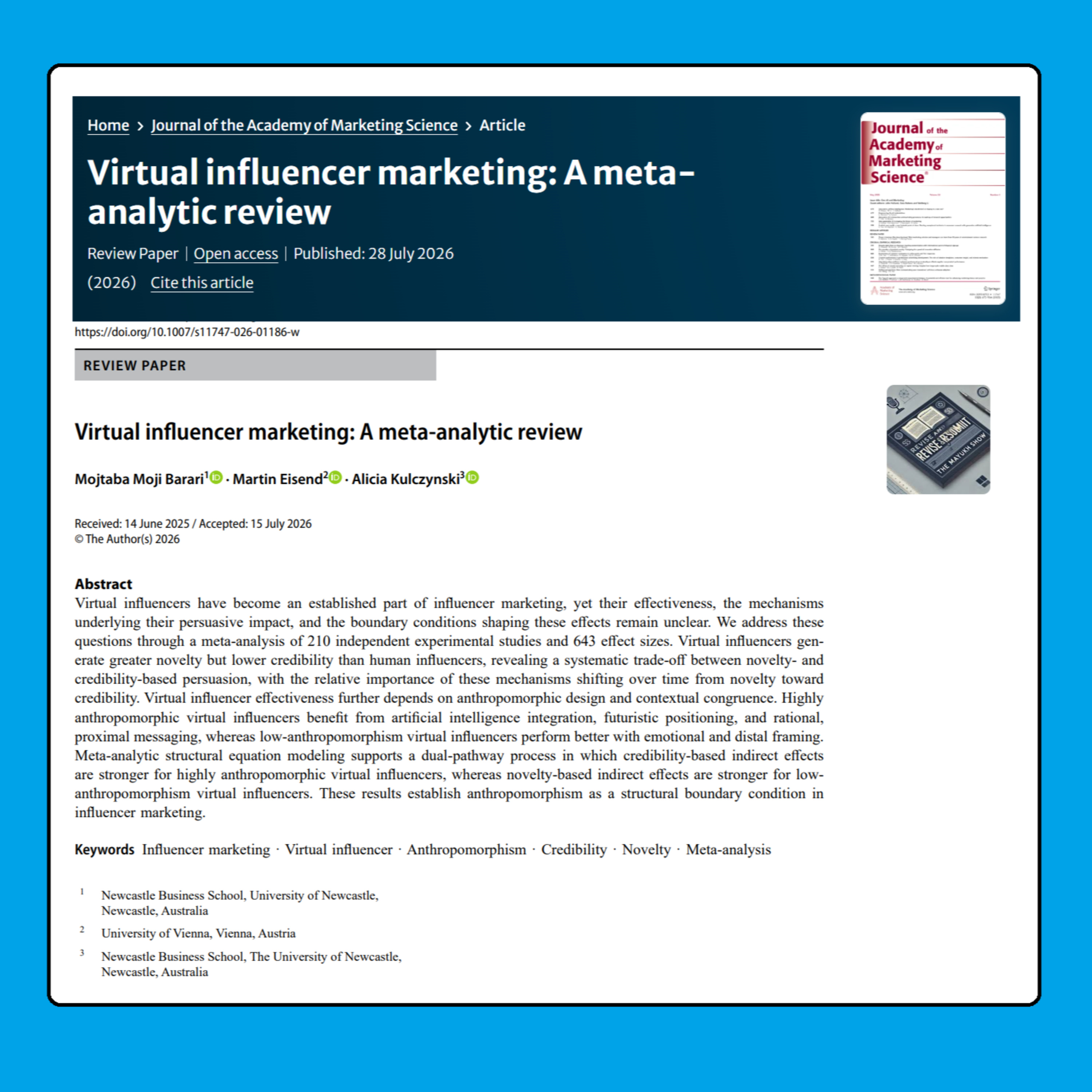
Virtual influencer marketing: A meta-analytic review (Barari et al., 2026) | FT50 JAMS
À propos de cet épisode
English Podcast Starts at 00:00:00
Bengali Podcast Starts at 00:42:13
Hindi Podcast Starts at 01:01:25
Danish Podcast Starts at 01:23:05
Reference
Barari, M. M., Eisend, M., & Kulczynski, A. (2026). Virtual influencer marketing: A meta-analytic review. Journal of the Academy of Marketing Science. https://doi.org/10.1007/s11747-026-01186-w
Youtube Channel
https://www.youtube.com/@weekendresearcher
Podcast Website
https://mayukhmukhopadhyay.com/reviseandresubmit
AOM SIM Curriculum Committee
https://sim.aom.org/curriculum/curriculum-committee
AOM SIM-Bytes Curriculum Lessons
https://sim.aom.org/curriculum/simbytes
🎙️✨ Welcome to Revise and Resubmit! 📚🚀
There are moments when the future arrives so quietly that we hardly notice it. One day, we are following people. The next, we find ourselves following digital creations that smile, speak, recommend, and even inspire us with surprising familiarity. It makes me wonder whether what moves us is authenticity itself, or simply our belief that we have found it. 🤖💭
In today's episode, I invite you to join me as we explore a fascinating research article, "Virtual Influencer Marketing: A Meta-Analytic Review," by Mojtaba Moji Barari, Martin Eisend, and Alicia Kulczynski. 🌟 Rather than offering another headline about artificial intelligence or social media trends, this remarkable study patiently gathers evidence from 210 independent experimental studies and 643 effect sizes, allowing the bigger picture to emerge with unusual clarity.
What I find especially compelling is that the story is not about technology replacing humanity. Instead, it is about the delicate balance between novelty and trust. ✨🤝 Virtual influencers capture our attention because they feel fresh and unexpected, yet credibility remains something far more difficult to manufacture. As audiences become increasingly familiar with these digital personalities, the excitement of novelty slowly fades, while the quiet importance of trust grows stronger. It feels less like a tale of machines competing with humans and more like an exploration of what persuasion has always depended upon.
The authors also uncover something deeply intriguing. The more human a virtual influencer appears, the more differently people respond to its messages, its intelligence, and even the products it represents. 🧠📱 In many ways, this research asks us to reconsider not only how brands communicate, but also how we ourselves decide whom to believe.
📖 What makes this paper even more significant is that it appears in the Journal of the Academy of Marketing Science, one of the world's most prestigious academic journals and a proud member of the FT50 journal list. That distinction reflects the journal's exceptional scholarly impact and the rigor of the research it publishes. 🏆🎓
So, come along with me as we unpack the evidence, question the assumptions, and discover what this landmark meta-analysis reveals about the evolving relationship between technology, marketing, and human psychology. 🌍💡
❓If the faces shaping our decisions no longer belong to real people, then what does authenticity truly mean in the age of artificial influence?
🙏 My sincere thanks to Mojtaba Moji Barari, Martin Eisend, and Alicia Kulczynski, and to Springer Nature, for making this outstanding research available to the academic community.
🎧💙 If you enjoy thoughtful conversations on cutting-edge research, please subscribe to Revise and Resubmit on Spotify, and subscribe to the Weekend Researcher YouTube channel. You can also find us on Amazon Prime and Apple Podcasts. Your support helps us bring more world-class research stories to curious minds everywhere. 🌟
Discussion 0
Connectez-vous pour participer à la discussion